USB4 and Thunderbolt 5: What They Mean for Video Capture Devices
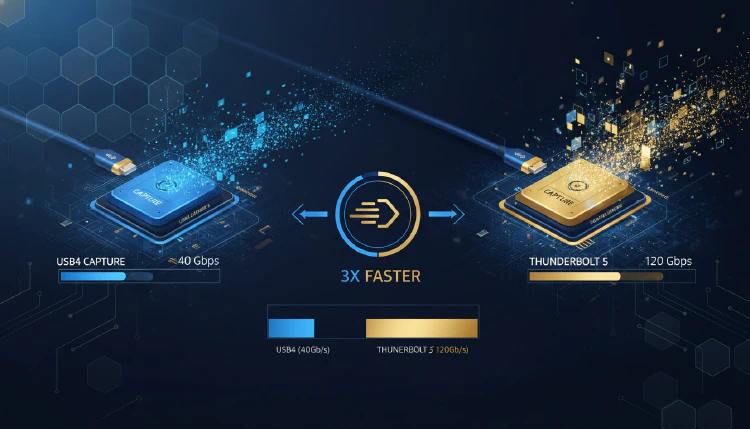
The bandwidth limitations of USB connections have long been the Achilles’ heel of external capture cards. While internal PCIe cards benefit from massive bandwidth, external USB 3.0 cards are limited to 5 Gbps — a bottleneck that restricts maximum capture quality. USB4 and Thunderbolt 5 are changing that equation dramatically.
Understanding the Bandwidth Leap
| Interface | Bandwidth | Relative Performance |
|---|---|---|
| USB 3.0 | 5 Gbps | Baseline |
| USB 3.2 Gen 2 | 10 Gbps | 2x |
| USB4 | 40 Gbps | 8x |
| Thunderbolt 4 | 40 Gbps | 8x |
| Thunderbolt 5 | 80 Gbps (120 Gbps asymmetric) | 16-24x |
Current USB4/Thunderbolt Capture Cards
Several manufacturers have already brought USB4 and Thunderbolt capture cards to market:
ACASIS Thunderbolt Capture Cards
ACASIS offers a lineup of Thunderbolt-connected capture cards supporting multiple HD resolution settings up to 4K@60Hz with 4-channel HDMI or SDI simultaneous input. Their flagship model supports up to 8 input sources through expansion — a capability that wasn’t practical with USB 3.0 bandwidth.
Maksedfish Thunderbolt Capture Cards
Maksedfish offers 4-in-1 Thunderbolt capture cards that capture four simultaneous video streams with ultra-low latency. Available in both SDI and HDMI variants, these cards support any resolution up to 1080p@60fps per channel.
ACASIS AC-TV003 USB4 Docking Station
The AC-TV003 combines a USB4 capture card with a docking station, featuring 4-channel HDMI capture alongside USB ports and display outputs — demonstrating the trend toward multi-function capture devices.
What Thunderbolt 5 Enables
Plugable Technologies explains that Thunderbolt 5’s 80 Gbps bandwidth (with 120 Gbps in asymmetric mode) eliminates the bandwidth limitations that have constrained external capture devices. Professionals can confidently use external capture cards, RAID drives, and AI enclosures without hitting bandwidth limits.
For video capture specifically, Thunderbolt 5 enables:
- 8K@60fps capture through external devices (previously only possible with internal PCIe cards)
- Multiple 4K@60fps streams captured simultaneously through a single connection
- Ultra-high bitrate recording matching or exceeding internal PCIe card capabilities
- Zero-compromise quality — external cards can finally match internal cards in raw performance
Backward Compatibility
An important advantage of Thunderbolt 5 is its full backward compatibility. As noted in the specifications, Thunderbolt 5 works with Thunderbolt 4, Thunderbolt 3, USB4, and USB 3 devices. This means existing capture cards will work with new Thunderbolt 5 ports, and new Thunderbolt 5 capture cards will work with older Thunderbolt ports (at reduced bandwidth).
The PCIe Advantage Narrowing
Historically, the primary argument for internal PCIe capture cards has been bandwidth. With Thunderbolt 5’s 80-120 Gbps matching PCIe 3.0 x4 (32 Gbps) and approaching PCIe 4.0 x4 (64 Gbps), external capture cards can now offer comparable performance without opening your computer case.
This shift is particularly significant for:
- Laptop users who have always been limited to external options
- Mac users whose systems often lack PCIe expansion slots
- Multi-system users who want to move their capture setup between machines
Looking Ahead
While dedicated Thunderbolt 5 capture cards are still emerging, the technology is ready. We expect 2026 to bring a wave of external capture devices that take full advantage of Thunderbolt 5’s bandwidth, finally eliminating the performance gap between internal and external capture solutions.
Sources: